Reverse-Engineered Writing Instruction That Improves Analytical Thinking
Reverse-Engineered Writing Instruction That Helps Students Think More Deeply, Clearly, and Originally
The ECCO Map System helps students build stronger writing by beginning with evidence first — improving originality, retention, and cross-curricular literacy
The ECCO Method
Most students struggle with writing because they are asked to form opinions before they fully understand the material.
The ECCO approach reverses this process by guiding students to begin with evidence first, allowing stronger analytical thinking to emerge naturally through structured connections and claims.
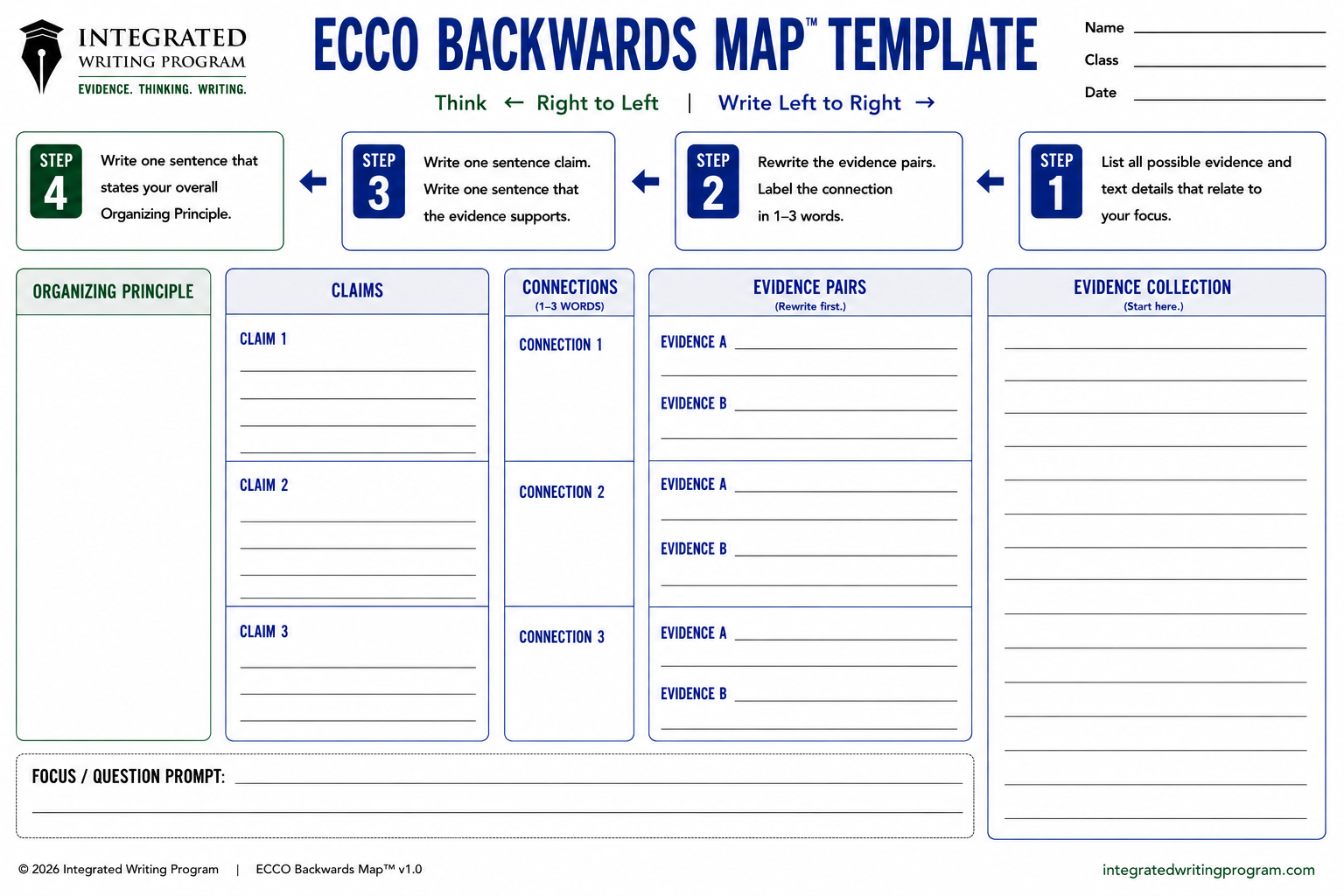
Evidence → Connections → Claims → Organizing Principles
The ECCO Map approach helps students:
organize information
identify meaningful patterns
develop analytical claims
synthesize larger ideas
improve confidence in writing and discussion
ECCO Mapping Template
The ECCO Map provides students with a structured process for organizing evidence, developing analytical claims, and building larger conceptual understanding.
Why Schools Use ECCO
The ECCO Map process helps students develop stronger analytical thinking by reversing the traditional writing process.
Instead of asking students to form opinions immediately, ECCO guides them to:
Collect evidence
Identify meaningful connections
Develop analytical claims
Organize larger conceptual understanding
This evidence-first approach improves:
Writing confidence
Originality
Close reading
Information retention
Cross-curricular literacy
ECCO has been successfully implemented with:
IB students
ESOL learners
General education classrooms
Intervention support
Cross-curricular instruction
Evidence of Growth
ECCO implementation has demonstrated measurable growth across multiple writing
modes through through internal Milestones simulation assessments.
A Schoolwide Literacy Framework
ECCO is designed to support analytical thinking across:
English/language arts
history and social studies
science
arts electives
AP and IB coursework
writing intervention programs
The strategies create consistency in how students organize information, develop ideas, and communicate understanding across disciplines.
Design
Create a challenging curriculum that allows writers to prove mastery
Facilitate
Lead student-centered classes where students take charge of their learning
Connect
Help students understand new material by scaffolding previous knowledge
Expand
Provide opportunities to engage with student-driven, original material
JON EPSTEIN, Ph.D.
Director, Integrated Writing Program
Jon Epstein, Ph.D., is the creator of the ECCO Map System, an instructional approach designed to help students develop stronger analytical thinking before formal writing begins.
Over the past 18 years, Jon has worked with students in IB programs, ESOL classrooms, intervention settings, and general education courses. Across those environments, he repeatedly encountered the same challenge: many students were being asked to produce sophisticated analytical writing before they had fully processed the material they were studying.
ECCO grew out of that problem.
Rather than beginning with a thesis statement, the ECCO Map asks students to start with evidence. Students collect details, identify patterns, develop connections, and gradually build larger analytical ideas. The process slows thinking down in productive ways and helps students develop more original and confident interpretations.
Over time, ECCO evolved beyond a writing strategy into a broader framework for visible analytical thinking. The approach has been used across subjects and grade levels to support close reading, discussion, evidence-based reasoning, and cross-curricular literacy instruction.
In recent years, ECCO has also become increasingly relevant in conversations surrounding AI-generated writing. Because the preparation emphasizes process, evidence collection, and visible reasoning, it helps teachers evaluate how students arrive at understanding rather than simply assessing finished products.
Current Consulting Work May Include
schoolwide implementation planning
professional development workshops
teacher coaching and modeling
writing intervention support
AP and IB analytical writing instruction
curriculum and literacy alignment